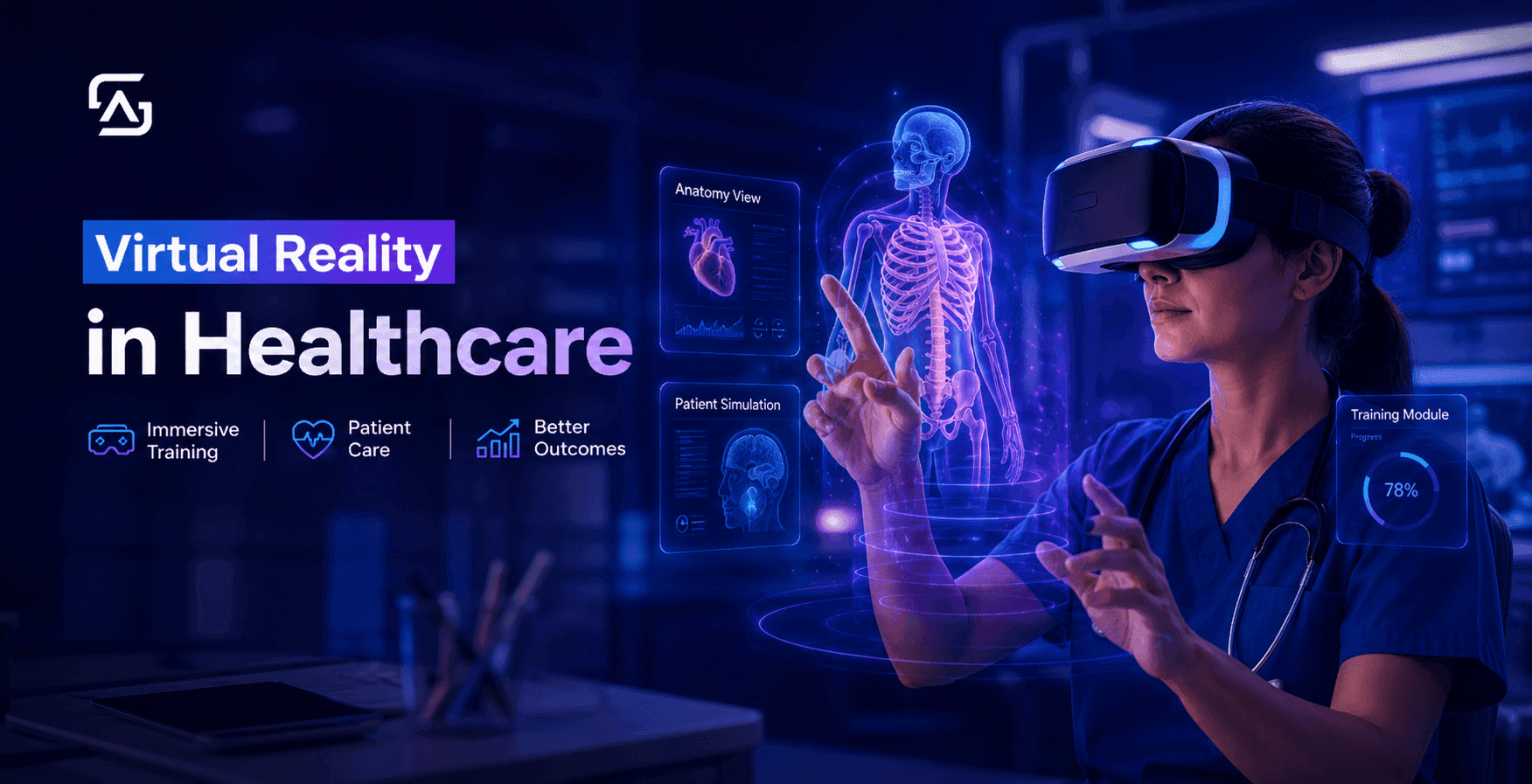
You've probably already seen virtual reality (VR) in gaming, education, or workplace training. However, many healthcare professionals and decision-makers still underestimate how deeply VR is changing patient outcomes, medical education, and clinical workflows. In this guide, we'll explain what virtual reality in healthcare is, why it matters, how it's being used today, and what opportunities it creates for the future of medicine.
Key Takeaways
- Virtual reality in healthcare enables immersive digital experiences for medical training, treatment, rehabilitation, and patient education.
- Medical education benefits from realistic simulations that allow healthcare professionals to practice procedures without patient risk.
- Pain management programs increasingly use VR as a non-drug intervention to reduce discomfort and anxiety during treatments.
- Rehabilitation therapies use interactive virtual environments to improve patient engagement and recovery outcomes.
- Mental health treatment leverages VR for exposure therapy, anxiety management, and PTSD support.
- Healthcare organizations are investing heavily in VR technologies as adoption expands across hospitals and clinics.
- Future healthcare delivery will combine VR, AI, telemedicine, and digital therapeutics into more personalized patient experiences.
What Is Virtual Reality in Healthcare?
Virtual reality in healthcare is the use of immersive computer-generated environments to improve medical training, patient treatment, rehabilitation, diagnosis, and healthcare education.
First, VR technology creates realistic digital environments that users experience through head-mounted displays and motion-tracking systems. Healthcare professionals use these environments to simulate surgeries, practice procedures, and enhance clinical decision-making.
For example, a surgeon can rehearse a complex operation using a patient-specific 3D model before entering the operating room. This preparation can improve confidence and procedural accuracy.
Moreover, patients can use VR experiences to manage pain, complete rehabilitation exercises, or receive mental health therapy in controlled virtual environments. These applications make healthcare more interactive and personalized.
Virtual reality transforms healthcare by making learning, treatment, and recovery more immersive.
How Does Virtual Reality Work in Healthcare?
Virtual reality works in healthcare by combining software, hardware, and clinical content to create immersive medical experiences.
Typically, a healthcare VR system includes:
- VR headsets
- Motion tracking sensors
- Clinical simulation software
- Interactive patient treatment applications
- Analytics and performance tracking tools
For example, nursing students can practice emergency response scenarios repeatedly without risking patient safety.
What Are the Main Components of Healthcare VR?
Healthcare VR consists of hardware, software, and specialized medical content.
According to Grand View Research, hardware accounted for more than 47% of VR healthcare revenue in 2024, highlighting the importance of headsets and immersive devices.
For example, devices such as Meta Quest and enterprise-grade medical headsets provide the visual immersion necessary for clinical training and patient therapy.
Why Does Virtual Reality in Healthcare Matter?
Virtual reality in healthcare matters because it improves clinical outcomes, enhances medical education, increases patient engagement, and reduces healthcare delivery limitations.
First, healthcare systems face growing challenges including workforce shortages, rising costs, and increasing demand for personalized care. VR helps address these issues by delivering scalable training and treatment solutions.
According to Grand View Research, the global VR healthcare market reached approximately $5.62 billion in 2024 and is projected to exceed $29 billion by 2030.
For example, hospitals can train hundreds of clinicians through standardized virtual simulations rather than relying solely on expensive in-person training programs.
- Virtual reality improves learning while reducing real-world training risks.
- Virtual reality increases patient engagement during treatment and recovery.
- Virtual reality expands healthcare access beyond traditional clinical settings.
Benefits for Healthcare Providers
Healthcare providers benefit from VR through safer training, improved efficiency, and better decision-making. Moreover, VR simulations allow repeated practice without requiring physical equipment, operating rooms, or live patients.
For example, surgical residents can perform virtual procedures dozens of times before working with actual patients.
Benefits for Patients
Patients benefit from VR through improved comfort, engagement, and treatment adherence.
In addition, immersive experiences help distract patients during painful procedures and motivate them during rehabilitation.
A 2024 systematic review published in BMC Medicine found evidence supporting VR's effectiveness for reducing pain during medical procedures.
How Is Virtual Reality Used in Healthcare Today?
Virtual reality is used in healthcare for medical training, surgical planning, pain management, mental health treatment, rehabilitation, and patient education.
Healthcare adoption continues expanding because immersive experiences can replicate situations that are difficult or costly to recreate in real life.
Application Area
- Medical Training
- Surgical Planning
- Pain Management
- Mental Health
- Rehabilitation
- Patient Education
Primary Use
- Clinical simulations
- Procedure rehearsal
- Distraction therapy
- Exposure therapy
- Recovery exercises
- Condition visualization
Key Benefit
- Safer learning
- Better accuracy
- Reduced discomfort
- Improved outcomes
- Higher engagement
- Better understanding
Virtual Reality for Medical Training
Virtual reality for medical training creates realistic simulations that improve clinical skills without risking patient safety. First, healthcare students can practice emergency medicine, anatomy, diagnostics, and surgical procedures in highly controlled environments.
According to industry estimates, healthcare training remains one of the largest VR application categories worldwide.
For example, a trainee can experience a virtual cardiac emergency multiple times until they master the required response protocol.
Virtual Reality for Surgical Planning
Virtual reality for surgical planning allows clinicians to visualize and rehearse procedures before operating.
Moreover, surgeons can interact with patient-specific anatomy using 3D imaging models.
For example, neurosurgeons can examine complex brain structures virtually before performing delicate procedures.
Virtual Reality for Pain Management
Virtual reality for pain management uses immersive experiences to reduce perceived pain and anxiety.
Research shows VR can divert attention away from painful stimuli through cognitive distraction mechanisms.
According to market research, the VR pain management segment generated more than $712 million in revenue during 2024.
For example, burn patients may use immersive nature experiences during wound care procedures to reduce distress.
How Does Virtual Reality Support Mental Health Treatment?
Virtual reality supports mental health treatment by providing controlled environments for therapeutic interventions.
First, therapists can safely expose patients to situations that trigger anxiety, phobias, or traumatic responses.
For example, someone with a fear of flying can gradually experience increasingly realistic flight scenarios while receiving therapeutic support.
- VR exposure therapy creates repeatable treatment environments.
- VR mental health programs increase patient participation.
- VR allows therapists to control treatment intensity.
- Virtual Reality for Anxiety and Phobias
- Virtual reality helps treat anxiety and phobias through structured exposure therapy.
Additionally, therapists can adjust environmental conditions in real time to match treatment goals.
For example, a patient with social anxiety may practice speaking in front of virtual audiences before facing real-world situations.
Virtual Reality for PTSD Treatment
Virtual reality assists PTSD treatment by recreating environments under clinical supervision.
Furthermore, clinicians can help patients process traumatic memories within controlled therapeutic settings.
For example, veterans and first responders may use VR-assisted therapy programs as part of broader treatment plans.
How Is Virtual Reality Used in Rehabilitation and Physical Therapy?
Virtual reality is used in rehabilitation by transforming repetitive exercises into engaging, goal-oriented experiences.
First, traditional rehabilitation often struggles with patient motivation and consistency. VR addresses this challenge through gamification and immersive feedback.
For example, stroke patients can practice arm movements while interacting with virtual games designed to support recovery.
Neurological Rehabilitation
Neurological rehabilitation uses VR to improve motor function, coordination, and cognitive recovery.
Moreover, therapists can customize exercises based on patient progress and clinical objectives.
For example, patients recovering from stroke may perform targeted movement exercises in interactive virtual environments.
Orthopedic Rehabilitation
Orthopedic rehabilitation uses VR to support recovery after injuries and surgeries.
In addition, virtual exercises can encourage patients to complete prescribed movements more consistently.
For example, a knee replacement patient may follow guided rehabilitation programs from home using VR technology.
What Challenges Limit Virtual Reality Adoption in Healthcare?
Virtual reality adoption in healthcare is limited by cost, implementation complexity, regulatory requirements, and content development challenges.
First, hospitals must invest in hardware, software, staff training, and technical support before achieving meaningful results.
For example, a healthcare organization may need dedicated infrastructure to deploy VR training programs across multiple departments.
Technology and Infrastructure Barriers
Technology barriers include hardware costs, integration challenges, and device management requirements.
According to industry reports, hardware remains the largest revenue category in healthcare VR deployments.
For example, large-scale deployment may require hundreds of managed devices across clinical locations.
Clinical Validation and Compliance
Clinical validation ensures VR solutions deliver measurable healthcare outcomes.
Additionally, healthcare providers must evaluate privacy, security, and regulatory considerations before implementation.
For example, patient treatment applications may require evidence demonstrating safety and effectiveness.
What Are the Best Virtual Reality Tools and Platforms for Healthcare?
The best virtual reality tools for healthcare combine clinical effectiveness, usability, scalability, and regulatory readiness.
First, organizations should identify their primary use case before selecting a platform.
Medical Training Platforms
Medical training platforms focus on simulation-based education and clinical skill development.
Examples include:
- Osso VR
- FundamentalVR
- SimX
- Oxford Medical Simulation
Rehabilitation and Therapy Platforms
Rehabilitation platforms support patient recovery through immersive exercises and guided programs.
Examples include:
- XRHealth
- MindMaze
- Penumbra REAL System
Free and Accessible Alternatives
Free alternatives provide opportunities to explore VR before enterprise adoption.
Examples include:
- Open-source VR development tools
- Educational anatomy applications
- University research platforms
What Is the Future of Virtual Reality in Healthcare?
The future of virtual reality in healthcare involves deeper integration with artificial intelligence, telemedicine, digital therapeutics, and personalized medicine.
According to Grand View Research, the healthcare VR market is projected to grow at a compound annual growth rate exceeding 30% through 2030.
For example, AI-powered VR systems could automatically adapt rehabilitation programs based on patient performance and biometric feedback.
- Healthcare VR is evolving from experimentation to mainstream clinical adoption.
- Immersive medicine will increasingly complement traditional healthcare delivery.
- AI and VR together will personalize treatment experiences at scale.
Emerging Trends to Watch
Emerging VR healthcare trends focus on accessibility, personalization, and clinical integration.
Key developments include:
- AI-assisted rehabilitation
- Digital therapeutics
- Virtual hospitals
- Remote patient monitoring
- Personalized treatment simulations
- Mixed reality surgical support
What Should Healthcare Organizations Do Next?
Healthcare organizations should begin with clearly defined use cases, measurable goals, and pilot programs.
First, identify whether training, rehabilitation, mental health, or patient education represents the highest-value opportunity.
Second, evaluate available VR platforms and assess integration requirements.
Third, launch a small pilot program and track measurable outcomes.
Fourth, scale successful programs gradually across departments.
By taking a structured approach, healthcare organizations can reduce implementation risks while maximizing clinical and operational benefits.
Conclusion
Virtual reality in healthcare is transforming how providers train clinicians, treat patients, and deliver care. Throughout this guide, we've explored how VR improves medical education, supports pain management, enhances rehabilitation, and expands mental health treatment options. As technology becomes more affordable and clinically validated, healthcare organizations will continue integrating immersive solutions into everyday care delivery.
Virtual Reality in Healthcare
Virtual reality in healthcare is transforming patient care, medical training, and rehabilitation. Discover benefits, use cases, challenges, and future trends.