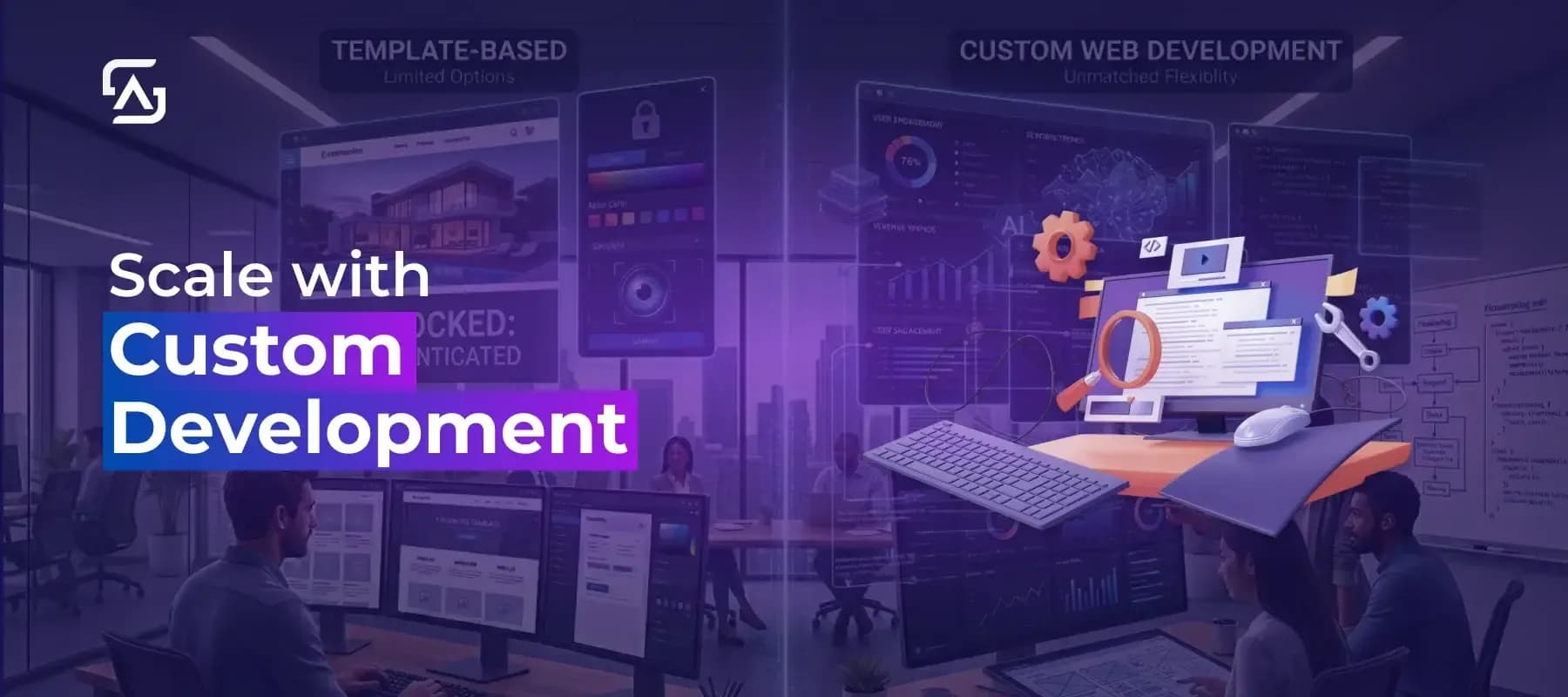
For US enterprises, custom web development is more than just building a website; it’s about creating a digital platform that truly supports the business. Off-the-shelf templates may be quick, but they rarely fit complex workflows or reflect a company’s brand. With tailored web solutions, businesses can design custom-built websites that scale as they grow, improve user experience in web design, and deliver measurable results.
Understanding the cost of custom web development and the benefits of tailored web solutions helps teams balance speed vs quality in website development while keeping up with modern web development trends.
In this article, we’ll discuss why bespoke web development outperforms template solutions for US enterprises. We will also discuss how scalable web solutions, superior UX, and seamless integrations can drive growth, efficiency, and brand trust, and how to make the right choices for your business.
Flexibility & Customization for Enterprise Needs
For US enterprises, website flexibility isn’t just a nice-to-have; it’s a critical factor in operational efficiency and growth. Off-the-shelf templates often appear convenient but come with rigid layouts, predefined workflows, and limited dashboards.
These limitations can disrupt internal operations, especially for organizations with complex processes and multiple departments. Templates also struggle with ERP, CRM, or analytics integrations, forcing teams to rely on manual workarounds. The human impact is significant: employees spend extra time reconciling data, workflows slow down, and brand consistency suffers.
For example, a US logistics company using a template couldn’t implement a real-time shipment tracking dashboard, which led to errors and wasted labor. In contrast, custom web development provides tailored web solutions that align with enterprise workflows, enhance efficiency, and support scalable operations.
Template Limitations
Templates often promise speed but at the expense of functionality and control. Fixed layouts and rigid navigation make it difficult for enterprises to adapt the website to complex workflows or unique business processes. Integrations with internal systems, such as ERP, CRM, or marketing automation, are typically limited, unreliable, or impossible, creating operational bottlenecks. Additionally, templates constrain branding and user experience in web design, making it harder for companies to differentiate themselves in competitive markets.
How Custom Development Provides Flexibility
With bespoke web development and frontend development, enterprises gain the ability to design custom-built websites that mirror their actual workflows and support long-term growth. Tailored web solutions, including intuitive frontend design, allow configurable dashboards, portals, and reporting tools, making operations smoother and more efficient. Custom websites can evolve over time, supporting new modules, features, or integrations without major redesigns, while ensuring a seamless user experience and interface.
For example, a US manufacturing company implemented a custom inventory management portal that automatically updated stock across multiple warehouses, something impossible with templates. Flexible platforms also improve user experience in web design, allowing employees and clients to interact with intuitive, streamlined interfaces. This adaptability reduces manual work, enhances productivity, and ensures the website remains a true strategic asset as business requirements change.
Actionable Checklist for Flexibility
To ensure a web development project delivers true flexibility, enterprises should evaluate solutions based on:
1: Ability to customize workflows without extensive coding. 2: Configurability of dashboards, portals, and reporting tools. 3: Capacity for modular expansion as the enterprise grows. 4: Full branding flexibility across all digital touchpoints. 5: Robust, maintainable integrations with ERP, CRM, and analytics systems.
Scalability - Growing With Your Business
For US enterprises, websites must grow alongside business needs. Templates are often rigid, making it difficult to add new features, handle increased traffic, or integrate evolving workflows. This can slow growth and increase operational costs.
Custom backend web development and bespoke web development deliver scalable web solutions that adapt to changing demands. Custom-built websites can expand modules, add integrations, and evolve interfaces without major redesigns. Enterprises can plan for future needs, ensuring websites remain strategic assets rather than constraints.
Template Bottlenecks
Templates may offer a fast start, but often fail under enterprise-scale demands. Fixed structures and limited functionality hinder scaling, especially when integrating with ERP, CRM, or analytics tools.
Templates are popular for speed, but their shared codebase exposes enterprises to repeated threats. Common vulnerabilities include outdated libraries, weak authentication mechanisms, and unpatched plugins, which can be exploited to access sensitive customer or business data.
Templates also lack fine-grained controls, making compliance with enterprise-level standards difficult. This often leads to reactive security management, increased operational overhead, and potential reputational damage for enterprises handling sensitive information.
How Custom Development Supports Growth
Bespoke web development enables enterprises to implement scalable web solutions that evolve with their business. Companies can add new modules, integrate advanced tools, and handle increased traffic without system disruption.
Decision Framework for Scalability
When evaluating web development for scalability, consider:
1: Ability to add modules or features without a full redesign.
2: Ease of integrating new systems or APIs.
3: Performance under increased traffic.
4: Capacity to maintain a consistent user experience in web design.
5: Long-term maintainability and alignment with enterprise goals.
Security & Compliance - Enterprise-Grade Protection
In US enterprises, website security isn’t optional; it’s a business-critical requirement. Templates often offer minimal protection, relying on generic updates and shared vulnerabilities.
In contrast, custom web development and bespoke web development allow enterprises to implement tailored web solutions that meet strict security standards, regulatory requirements, and compliance mandates such as GDPR, CCPA, and HIPAA.
Custom-built websites enable deeper control over authentication, encryption, and user access, protecting sensitive data and reducing operational risk. Investing in enterprise-grade security ensures business continuity, builds client trust, and avoids costly breaches, all while maintaining a secure user experience in web design.
Custom Solutions for Enterprise Security
Bespoke web development empowers enterprises to build websites with integrated security from the ground up. Developers can enforce role-based access, encrypted databases, secure API integrations, and automated patch management. Custom-built sites allow continuous monitoring and proactive threat detection, reducing downtime and exposure to cyber-attacks.
Human & Operational Impact
Security isn’t just technical; it affects daily operations and employee workflows. Weak template security often forces IT teams into constant firefighting, disrupting business operations and lowering productivity.
Custom solutions, streamline security management, allowing IT staff to focus on strategic initiatives like monitoring user access and maintaining compliance. Employees experience fewer interruptions, while enterprise clients enjoy safer, more reliable interactions. The result is reduced operational risk, improved efficiency, and higher customer confidence.
Security Checklist
To evaluate enterprise-grade security, consider:
- Are authentication and access controls customizable and robust?
- Is sensitive data encrypted at rest and in transit?
- Are APIs, plugins, and integrations continuously monitored for vulnerabilities?
- Does the website comply with GDPR, CCPA, HIPAA, or industry-specific regulations?
- Are automated monitoring and patching systems in place to prevent breaches?
Unique User Experience (UX) & Branding
For US enterprises, websites are more than functional platforms; they reflect brand identity and influence operational efficiency. Custom-built websites and bespoke web development allow tailored web solutions that balance speed vs quality in website development, delivering seamless navigation, interactive elements, and consistent branding.
Enterprises investing in custom-built websites can implement scalable web solutions that grow with business needs while improving engagement and operational efficiency.
Custom UX & Branding Benefits
Bespoke web development allows enterprises to create tailored web solutions that align with user behavior and brand standards. Custom-built websites support interactive dashboards, personalized workflows, and responsive designs, enhancing user experience in web design.
US fintech and healthcare companies implementing these solutions reported higher task completion rates and fewer support tickets, demonstrating measurable operational improvements. Custom UX also enables scalable web solutions, ensuring that growth and new feature integrations do not compromise usability.
UX Evaluation Checklist
To evaluate enterprise-grade UX and branding:
1: Does the platform reflect company branding consistently?
2: Are navigation flows intuitive for employees and clients?
3: Is the interface optimized for mobile and accessibility standards?
4: Can dashboards and interactive elements be customized to support scalable web solutions?
5: Are usability metrics tracked to measure the benefits of tailored web solutions?
This ensures custom-built websites and bespoke web development deliver long-term operational value, superior user experience in web design, and alignment with web development trends.
Custom Integration Advantages
Bespoke web development enables enterprises to implement seamless integrations tailored to business workflows. APIs can connect CRMs, ERPs, payment systems, and analytics tools, enabling automated data flow and reducing errors.
For example, a US logistics firm implemented a custom-built website integrated with its ERP system, reducing manual order processing by 40% and improving real-time reporting.
Custom integration ensures that tailored web solutions scale efficiently, maintain security standards, and deliver superior operational performance without compromising user experience in web design.
Integration Checklist
Enterprises evaluating web integration should ensure:
- APIs connect front-end and back-end systems seamlessly.
- Data flows are automated to prevent duplication or errors.
- Integrations support scalable web solutions for future growth.
- Security standards and compliance are maintained across systems.
- Integration supports measurable KPIs for operations, user engagement, and ROI.
With custom web development and bespoke web development, enterprises gain tailored web solutions that connect all business systems, optimize workflows, and deliver a superior digital experience.
Long-Term ROI & Maintainability
Enterprise websites are long-term assets. While templates reduce upfront costs, they often incur hidden expenses in maintenance, updates, and workaround integrations. Custom-built websites and bespoke web development provide tailored web solutions that scale, adapt, and support evolving business needs.
Custom Development as Investment
Bespoke web development is an upfront investment that pays off in maintainability, flexibility, and operational efficiency. Custom-built websites allow enterprises to implement automated workflows, seamless system integrations, and tailored UX. For example, a US fintech firm using a custom-built portal reduced operational costs by 30% annually while increasing user retention and task completion rates.
ROI Evaluation Framework
Enterprises can evaluate ROI by considering:
1: Total cost of ownership, including maintenance and integrations
2: Impact on conversions, engagement, and operational efficiency
3: Reduction in manual workflows and support requirements
4: Flexibility to adopt web development trends without additional rebuilds
5: Alignment with long-term business growth and scalable web solutions
Using this framework ensures that custom web development is positioned as a strategic, enterprise-grade investment rather than just a one-time expense.
Red Flags When Choosing a Web Development Partner
Choosing the wrong partner for custom web development can cost US enterprises time, money, and reputation. Even experienced teams falter when partners lack transparency, experience, or shared goals.
Warning Signs
One of the most common red flags is poor communication; slow responses, vague answers, or no structured project management system. Clarity in timelines, deliverables, and process milestones is critical for enterprise projects.
Another warning sign is ambiguous pricing or hidden costs; reputable partners provide detailed cost breakdowns instead of vague quotes.
Additionally, partners who overpromise unrealistic timelines or enormous results without data to back them up often under‑deliver.
Human & Operational Considerations
Lack of transparency and poor project discipline affect teams on a human level. Delayed or unclear communication creates confusion across departments and leads to missed milestones.
If a partner doesn’t have a clear development process or dedicated project manager, it’s a strong indicator of future friction. Enterprises should also watch for developers who can’t translate technical concepts into business outcomes, a sign they’re focused on code rather than business impact.
Partner Evaluation Checklist
Use this checklist to screen potential partners:
- Clear communication channels and response expectations.
- Transparent pricing with detailed cost breakdowns.
- A robust, industry‑specific portfolio and references.
- Structured development process with milestones.
- Commitment to post‑launch support and maintenance.
These indicators help ensure you choose a partner capable of delivering tailored web solutions, and avoid common pitfalls that drain enterprise resources.
Conclusion
For US enterprises, the cost of custom web development is an investment in long-term efficiency, scalability, and brand value. Unlike templates, bespoke web development delivers tailored web solutions that enhance UX, integrate seamlessly with enterprise systems, and support future growth.
By prioritizing flexibility, security, and operational alignment, businesses gain websites that drive measurable results, reduce friction, and strengthen client trust. Choosing the right approach and partner ensures your digital platform is not just a website, but a strategic asset that grows with your enterprise.
Unlock the Power of Tailored Solutions for Your Business
Discover why custom web development is the key to outpacing competitors with unique, scalable, and high-performance websites built specifically for your needs.